Andrej Karpathy & Will Depue on Latent Demand for AI Reflexes: Why Autonomous Agents Die Without System 1
When Andrej Karpathy analyzed Will Depue's viral debate on Jev, he pinpointed the exact structural flaw freezing autonomous agents: forcing LLMs to 'think' for 1,400ms on zero-reasoning micro-tasks. Here is the full engineering breakdown.
It started with Will Depue noticing something unexpected across developer feeds:

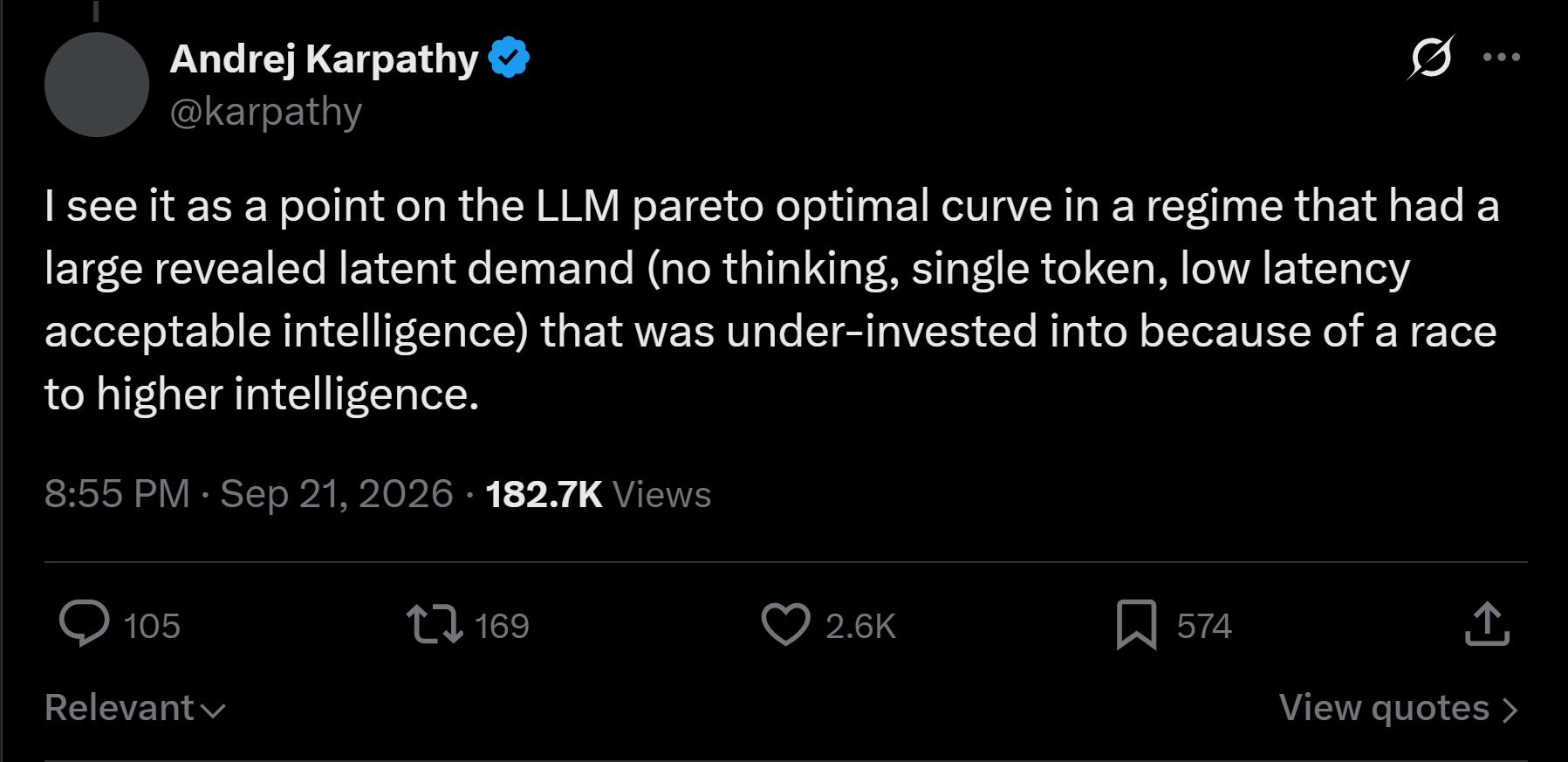
Then Andrej Karpathy dropped the comment that cut straight to the core of the problem:
What Karpathy's "Pareto Curve" Actually Means in Plain English
Let's strip away all the academic buzzwords.
For the last three years, the entire artificial intelligence industry has been locked in an arms race to make models smarter, bigger, and slower. Labs trained giant models to write poetry, solve complex mathematics, and generate pages of step-by-step reasoning tokens before speaking.
That is System 2 AI: slow, deliberate, deep thinking.
It works wonders if you need a legal contract analyzed or a novel algorithm designed. But when engineers started connecting these models into autonomous agent loops—where an agent reads a file, runs a bash command, checks the exit status, and picks the next tool—something catastrophic happened.
The 1,400ms Agent Freeze
Every single micro-decision in the loop—such as checking whether a command succeeded or whether a safety filter triggered—forces the agent to wait 1,400 milliseconds and burn thousands of tokens in autoregressive generation. An agent executing 20 steps takes over 30 seconds of pure idle waiting, draining dollars for simple binary checks.
Why Autonomous Agents Need a Spinal Cord (System 1)
Think about how your own body works.
When you accidentally touch a hot stove, your hand pulls back before you even realize the stove is hot. Your brain does not sit down, write an outline, evaluate three counter-arguments, and ponder whether to retract your fingers.
The signal travels to your spinal cord, fires an immediate reflex arc in under 20 milliseconds, and pulls your arm away. That is System 1.
Until recently, AI agent architectures had zero spinal cords. Every single reflex—routing a tool, verifying a regex, checking safety limits, or validating JSON—had to travel thousands of miles to a cluster of cloud GPUs running an 800-billion-parameter reasoning model.
As Karpathy noted, there was a massive, pent-up latent demand for "no thinking, single token, low latency acceptable intelligence" that the entire industry ignored while racing towards higher reasoning benchmarks.
How Modern Engineering Teams Solve This in Production
Instead of routing every micro-decision through a giant autoregressive LLM, leading agent developers are decoupling the architecture into two distinct tiers:
- The Reflex Layer (System 1): High-speed non-autoregressive classifiers and calibrated decision models that resolve tool choices, guardrails, classification, and execution validation in under 25 milliseconds for a fraction of a cent.
- The Deliberation Layer (System 2): Frontier reasoning engines (like Claude 3.7 or GPT-4o) that are called exclusively when deep synthesis, novel architecture, or complex creative generation is genuinely required.
In practical deployments, platforms like JevProxy (jevproxy.com) act as the dedicated socket-level gateway. By intercepting agent traffic right at the network boundary, JevProxy executes calibrated decision routing and safety checks in sub-20ms without waking up the main frontier model, instantly cutting agent runtimes by 80% and token bills by 90%.
The Road Ahead: The Rise of System 1 Infrastructure
The public debate between Karpathy and Depue signals a pivotal transition for the AI ecosystem. The initial gold rush of building ever-larger reasoning models is reaching diminishing returns for real-time production software.
The next wave of high-value AI infrastructure belongs to the reflex layer: low-latency, deterministic, single-token decision models that give autonomous systems real-time reflexes.
Infrastructure Governance & Registrar Transfer
The canonical domain SystemOneAPI.com is available for corporate acquisition or enterprise licensing. Official registrar push available via Spaceship or Escrow.com security with immediate EPP authorization release.