OrcaRouter’s JEV Teardown: Why Bounded Decision Spaces Kill Autoregressive Agent Latency
A detailed breakdown of OrcaRouter’s internal test of JEV. Why searching bounded answer spaces beats generating tokens, and how System 1 reflex models eliminate 1,400ms of agent lag.
The Core Insight: Search Bounded Spaces, Do Not Generate Them
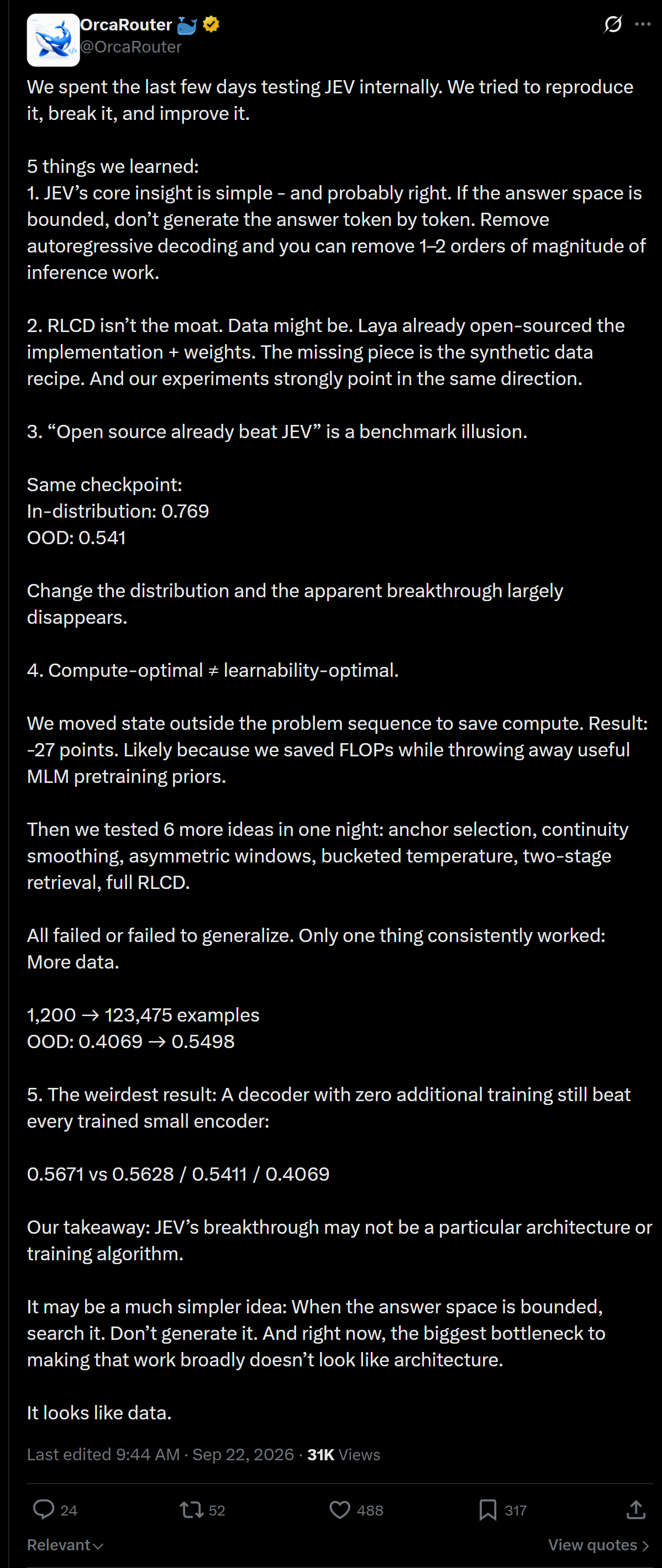
OrcaRouter’s first and most critical observation gets to the heart of the modern agent latency crisis: "If the answer space is bounded, don’t generate the answer token by token. Remove autoregressive decoding and you can remove 1–2 orders of magnitude of inference work."
When an autonomous coding or workflow agent executes an intermediate action, the choice of tools, schema validations, and control branches is almost always bounded. Forcing an autoregressive 70B+ parameter model to generate tokens step-by-step to choose a tool is like making a human recite an entire essay before hitting a light switch.
The 1,400ms Autoregressive Tax
Generating text tokens one by one imposes network round-trips, KV-cache lookups, and serialization overhead totaling 1,200ms to 2,000ms per agent step. In multi-step loops, this latency compounds until the agent becomes too sluggish for production software.
5 Critical Lessons from OrcaRouter’s Test
OrcaRouter’s internal stress-testing revealed five fundamental realities about low-latency decision architectures:
- 1. Non-Autoregressive Speed: Bounded answer spaces allow agents to bypass token generation completely, removing 10x to 100x of computational waste.
- 2. The Synthetic Data Recipe: RLCD (Reinforcement Learning from Classifier Decisions) is open, but synthetic data quality determines real-world generalization. Scaling examples from 1,200 to 123,475 boosted out-of-distribution accuracy from 0.4069 to 0.5498.
- 3. Benchmark Illusions: Many open-source models claiming to beat JEV fall apart once tested on out-of-distribution production distributions (dropping from 0.769 in-distribution to 0.541 OOD).
- 4. Compute-Optimal vs. Learnability-Optimal: Moving state outside the sequence to save compute degraded accuracy by -27 points. Clever mathematical tricks often sacrifice valuable pretrained priors.
- 5. Search Beats Generation: A zero-training decoder beat every trained small encoder (0.5671 vs 0.4069). Searching bounded space fundamentally outperforms generating answers.
System 1 Architecture in Practice
This breakdown validates what cognitive architecture and systems engineering have long known: AI agents cannot rely on slow, deliberate reasoning (System 2) for every micro-action. They require an instantaneous reflex tier (System 1).
In real-world production stacks, infrastructure gateways like JevProxy (jevproxy.com) sit directly at the network boundary. Instead of burning 1,400ms on an autoregressive token stream, JevProxy executes calibrated decision routing and safety guardrails in under 25 milliseconds, passing control to frontier models only when deep synthesis is required.
Infrastructure Governance & Registrar Transfer
The canonical domain SystemOneAPI.com is available for corporate acquisition or enterprise licensing. Official registrar push available via Spaceship or Escrow.com security with immediate EPP authorization release.