Ricker’s JEV Architecture Teardown: Why Moving LLMs Out of Decision Loops Makes Agents 193x Faster
Autonomous agent stacks are bleeding latency and cash because frontier models are asked to make mechanical routing decisions. Here is why control systems need a reflex layer.
The Silent Leak Inside Every Modern Agent Stack
If you look at the trace of almost any autonomous coding agent, researcher, or workflow orchestrator built in 2025 or 2026, you see the exact same pattern. An expensive frontier model sits in an execution loop answering binary questions:
- "Did the command succeed? (Yes / No)"
- "Which subagent should handle this task? (Coder / Researcher / Reviewer)"
- "Is this tool output relevant to the user query? (Score 0-1)"
- "Does this shell command require security escalation? (Allow / Block)"
Every single one of these micro-evaluations is forced through an autoregressive language model. The model has to ingest 30,000 tokens of conversation history, wake up billions of parameters, and generate output text character by character.
The result? Each micro-decision burns 1,200 to 2,000 milliseconds of network and inference round-trips and racks up cents per step. In a complex loop running 50 steps, the agent spends 75 seconds just waiting for decisions that never required prose generation in the first place.
The 193x Speedup: Zero-Generation Tokens
Ricker’s benchmarks highlight the radical difference between generation and classification. In controlled tests, isolating control decisions into dedicated non-autoregressive classifiers delivered up to 193x faster execution and 444x lower cost. Why? Because the control layer generated exactly zero prose tokens.
Deconstructing Ricker’s 10-Step Control Pipeline
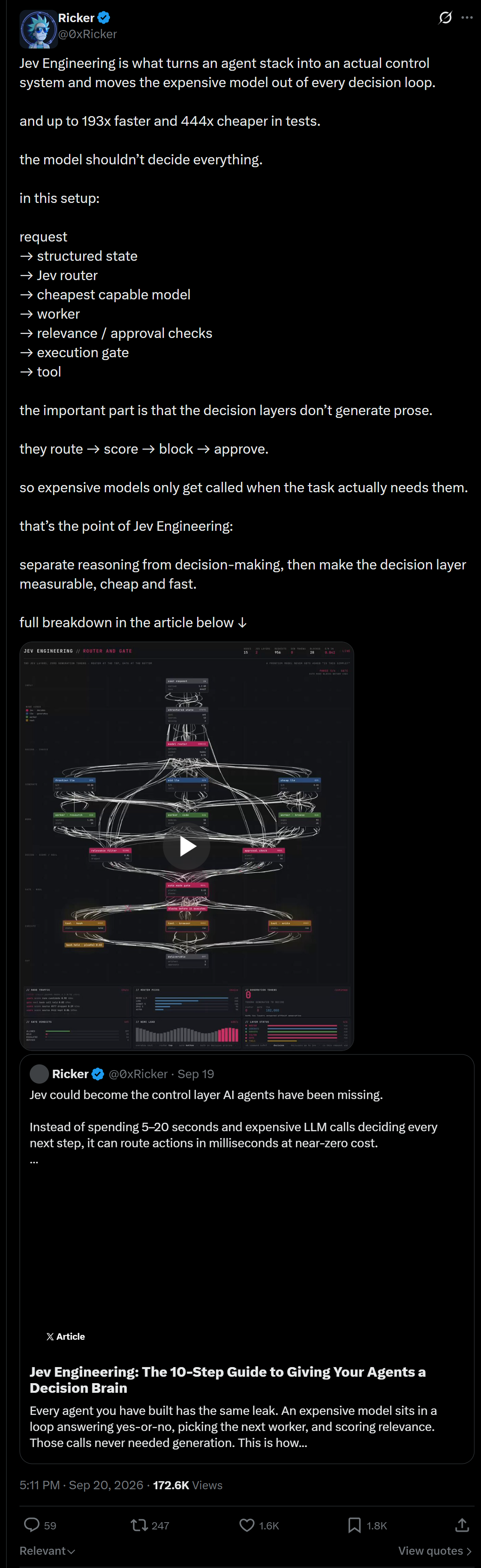
In his teardown, Ricker presents an architectural flow that separates reasoning from deterministic control. Instead of treating the frontier LLM as both the thinker and the traffic cop, the pipeline splits responsibility cleanly:
Notice what happens at the crucial nodes marked in green: they route, score, block, and approve. At no point does the router or the gate generate freeform creative text. It operates on bounded spaces. If a task only has four possible tool destinations, generating tokens to select one is pure computational waste.
System 1 Reflexes vs. System 2 Deliberation
This architecture directly mirrors human biology. When you touch a hot stove, your spinal cord pulls your hand back before the pain signal even reaches your cerebral cortex. That is a System 1 reflex. You do not write an essay or deliberate over whether heat is bad before retracting your fingers.
Current AI agent designs force the cerebral cortex (frontier LLMs like GPT-5 or Claude Sonnet) to handle spinal reflexes. Every tool verification, schema match, and lint check wakes up the entire brain. By decoupling the reflex layer from the reasoning layer, software engineers unlock true low-latency autonomous loops.
In production environments, engineering teams use gateways like JevProxy (jevproxy.com) to intercept agent calls directly at the network socket. By evaluating router candidates, guardrails, and validation criteria in under 25 milliseconds, the system preserves expensive frontier LLM calls strictly for complex creative synthesis and code refactoring.
The Takeaway for Developers
As Andrej Karpathy pointed out earlier this week, the industry was so fixated on racing toward higher frontier intelligence that it neglected the massive latent demand for single-token, zero-latency micro-intelligence.
Ricker’s blueprint demonstrates that solving agent performance is not about waiting for frontier models to get 10% faster. It is about restructuring your pipeline so the expensive model is only invoked when true reasoning is required.
Infrastructure Governance & Registrar Transfer
The canonical domain SystemOneAPI.com is available for corporate acquisition or enterprise licensing. Official registrar push available via Spaceship or Escrow.com security with immediate EPP authorization release.