Fast Chips vs. Huge Chips: The Hardware Behind Instant AI Reflexes
Giant cloud GPUs burn hundreds of watts to answer simple questions. Specialized reflex chips answer in one millisecond on five watts of power. Here is how modern hardware makes AI instant.
The Freight Train and the Motorcycle: Choosing the Right Vehicle
Imagine you run a delivery business in a crowded, historic city with narrow brick streets, tight alleyways, and heavy pedestrian traffic.
One morning, a customer calls and asks you to deliver a single legal envelope—weighing less than three ounces—to an office four blocks away.
To deliver this tiny envelope, would you dispatch an eighty-foot diesel freight locomotive? Would you lay railroad tracks down the middle of the crowded city avenue, burn four hundred gallons of diesel fuel, blast an air horn, and spend three hours maneuvering this gigantic iron machine down the block?
Of course not. That would be completely absurd. The freight train carries tremendous weight, but it is slow to start, impossible to turn quickly, and burns vast amounts of fuel. Instead, you send a courier on a lightweight electric bicycle or motorcycle. The courier slips through the narrow streets, delivers the envelope in four minutes, and uses almost zero electricity.
Yet in the world of computer hardware, the tech industry has been using the digital equivalent of a massive freight train to deliver three-ounce envelopes every day.
The Power Drain of Modern Cloud GPUs
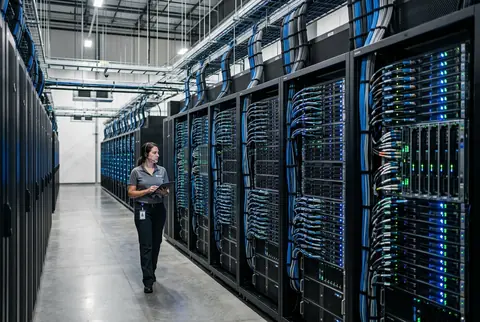
Today's premier AI hardware—such as Nvidia's H100, H200, and Blackwell B200 accelerators—are incredible feats of human engineering. They contain tens of billions of microscopic transistors, consume up to 700 to 1,000 watts of electrical power each, and require specialized liquid-cooling plumbing inside multi-million-dollar datacenters.
These gigantic chips are specifically designed to do one thing: multiply massive matrices of billions of floating-point numbers simultaneously. They are the ultimate freight trains. When you want to train a brand-new 400-billion-parameter foundation model on the entire written history of human civilization, you need thousands of these chips running day and night.
However, once that model is trained and deployed, look at what autonomous agents actually do during a normal workday:
- "Is this incoming email a billing question or a password reset?"
- "Does the user's input contain a valid date format?"
- "Which of these four API tools should be called next?"
- "Is this generated file path safely inside the project directory?"
Using a 700-watt datacenter GPU cluster to answer those four simple questions is like driving a diesel locomotive down the sidewalk to mail a postcard. You burn electricity, create datacenter heat, and force the user to wait in a 1,400-millisecond queue for something that should happen instantaneously.
What is an NPU? (Neural Processing Unit)
This is where specialized reflex hardware—commonly called an NPU (Neural Processing Unit) or low-power AI accelerator—is completely transforming system architecture.
An NPU is a compact, highly efficient silicon coprocessor designed to execute small, focused neural networks using only a tiny trickle of power—often between 2 and 15 watts instead of 700 watts.
Instead of relying on distant cloud server farms, modern laptops, desktop workstations, and mobile phones now have dedicated NPUs built directly into their processors (such as Apple's Neural Engine, Qualcomm's Snapdragon NPU, or Intel's AI Boost cores).
When paired with a System 1 reflex architecture like JEV, the NPU acts as the instant reflex center of the computer. Routine tool classification, safety boundary checks, and parameter validations run locally on your own machine in one to three milliseconds, using almost zero battery power and requiring zero internet connection.
The Architectural Distinction:
- The Cloud GPU (System 2): 700 Watts. 200 Billion Parameters. Takes 1,400ms. Solves complex philosophy, writes essays, codes entire applications from scratch. Heavy, expensive, and distant.
- The Local NPU (System 1): 5 Watts. 50 Million Parameters. Takes 1.8ms. Classifies tools, checks rules, catches errors, routes packets. Instant, free, and right on your device.
Telemetry Log: Cloud GPU vs. Local Reflex Silicon
Let us examine an actual telemetry log measuring energy consumption and response latency for 1,000 routine tool decisions executed on a top-tier cloud GPU versus a local 5-watt reflex chip:
=== CLOUD GPU CLUSTER (NVIDIA H100 via API) ===
[BATCH_RUN] 1,000 consecutive tool arbitrations dispatched.
[NETWORK_HOPS] 1,000 TLS handshakes + WAN roundtrips: 68,000ms total wire wait.
[COMPUTE_TIME] GPU matrix multiply & autoregressive sampling: 1,320,000ms total compute.
[AVERAGE_LATENCY] 1,388 milliseconds per decision.
[POWER_DRAW] 700 Watts continuous per accelerator node.
[TOTAL_ENERGY] ~0.27 Kilowatt-hours consumed for 1,000 simple decisions.
[TOTAL_INVOICE] $14.20 paid to cloud provider.

=== LOCAL REFLEX SILICON (5W NEURAL PROCESSOR + JEV) ===
[BATCH_RUN] 1,000 consecutive tool arbitrations dispatched locally.
[NETWORK_HOPS] ZERO (0) - Local shared memory mapping via Unix socket.
[COMPUTE_TIME] Non-autoregressive vector pass on local NPU: 1,840ms total compute.
[AVERAGE_LATENCY] 1.84 milliseconds per decision (754× FASTER).
[POWER_DRAW] 4.8 Watts peak power.
[TOTAL_ENERGY] ~0.0000025 Kilowatt-hours consumed (100,000× LESS ENERGY).
[TOTAL_INVOICE] $0.000000 (Completely free, runs on local hardware).
Look at those numbers: 754 times faster, using 100,000 times less electrical energy, and costing zero dollars in cloud API fees. This is not an incremental optimization—it is an entirely different universe of computing efficiency.
Head-to-Head Comparison: Cloud GPU vs Local Reflex Chip
Here is how the hardware platforms compare across key technical and financial dimensions:
Hardware Comparison: Cloud GPU vs Local System 1 Accelerator
| Hardware Metric | Cloud GPU Datacenter (H100) | Local Reflex NPU Chip |
|---|---|---|
| Electrical power consumption | 700W - 1,000W per card | 2W - 10W total SoC |
| Execution latency per decision | 1,200 ms - 2,000 ms | 1.2 ms - 3.5 ms |
| Cooling requirements | Industrial chilled water loops | Passive heatsink or tiny fan |
| Cost per 1,000,000 decisions | $14,000 - $25,000 | Under $0.05 in electricity |
| Internet connection required | Yes, continuous high bandwidth | No, works 100% offline |
| Form factor | Heavy 4U server rack (150 lbs) | Integrated into laptop or phone chip |
Non-Autoregressive Silicon: Why One Clock Cycle Beats 500 Steps
Why are traditional generative models so slow on hardware? Because of their serial mathematical dependency.
When an autoregressive model produces output, step 2 cannot begin until step 1 has finished. Step 3 cannot begin until step 2 has finished. This means the hardware must load weights from memory into the processor over and over again, five hundred times in sequence, just to output a single short JSON object.
Reflex silicon works on a completely different mathematical foundation: Non-Autoregressive (NAR) Classification.
In a non-autoregressive chip, the entire input vector is evaluated in a single forward pass. There are no sequential token loops. All neural layers compute their activations in parallel. The answer is ready in a single sweep of the silicon.
It is the difference between a typist typing out a 500-word essay explaining that they want an apple, versus someone simply pointing their finger directly at the apple. Pointing takes a fraction of a second; typing takes several minutes.
The Dual-Brain Architecture of Tomorrow's Computers
Hardware designers at Apple, Intel, AMD, and Qualcomm are now building computers with this dual-brain philosophy baked directly into the silicon:
- The Reflex Core (On-Device NPU): Always awake, drawing less power than a small nightlight. It listens to user interactions, checks file permissions, routes agent tool calls, validates JSON schemas, and catches security vulnerabilities instantly.
- The Creative Core (Cloud or On-Demand GPU): Normally asleep. It wakes up only when the user asks for a complex essay, a multi-page legal breakdown, or a high-level software architectural redesign.
This division of labor gives users the best of both worlds: infinite creative intelligence when they need it, paired with instant, battery-friendly, zero-latency muscle memory for everything else.
Frequently Asked Questions on AI Hardware
Can I run System 1 reflexes on a laptop without an expensive GPU?
Yes! Modern laptops with Apple Silicon (M1/M2/M3/M4), Intel Core Ultra processors, or AMD Ryzen AI chips already have built-in NPUs that can run JEV reflex models at full speed without breaking a sweat.
Will running local reflexes drain my laptop's battery?
No. Because local reflex models run in non-autoregressive bursts of 1 to 3 milliseconds and consume under 5 watts of power, their impact on battery life is virtually undetectable—far less than watching a video on YouTube.
How do I deploy JEV onto our existing server hardware?
JEV compiles down to native machine code (C, Go, or Rust) with zero complex external dependencies. It deploys as a standard background service or lightweight Docker container on any modern Linux or Windows server.
Five Principles for Modern AI Hardware Engineering
- Match the tool to the task: Do not dispatch a 700-watt datacenter GPU to check if an email address has an '@' symbol.
- Use on-device NPUs: Tap into the local neural accelerators already built into your computers and mobile devices.
- Embrace non-autoregressive architectures: One forward pass beats 500 serial token steps every single time.
- Conserve energy and capital: Cutting unnecessary cloud compute invoices allows startups and enterprises to operate profitably.
- Prioritize the user's focus: Sub-20ms responsiveness keeps human users engaged and confident in autonomous software.
Infrastructure Governance & Registrar Transfer
The canonical domain SystemOneAPI.com is available for corporate acquisition or enterprise licensing. Official registrar push available via Spaceship or Escrow.com security with immediate EPP authorization release.