Reverse-Engineering the Tool Execution Bottlenecks in Cursor and Claude Code
Kernel-level eBPF traces reveal where modern AI coding companions spend their time during terminal commands, file search, and test execution.
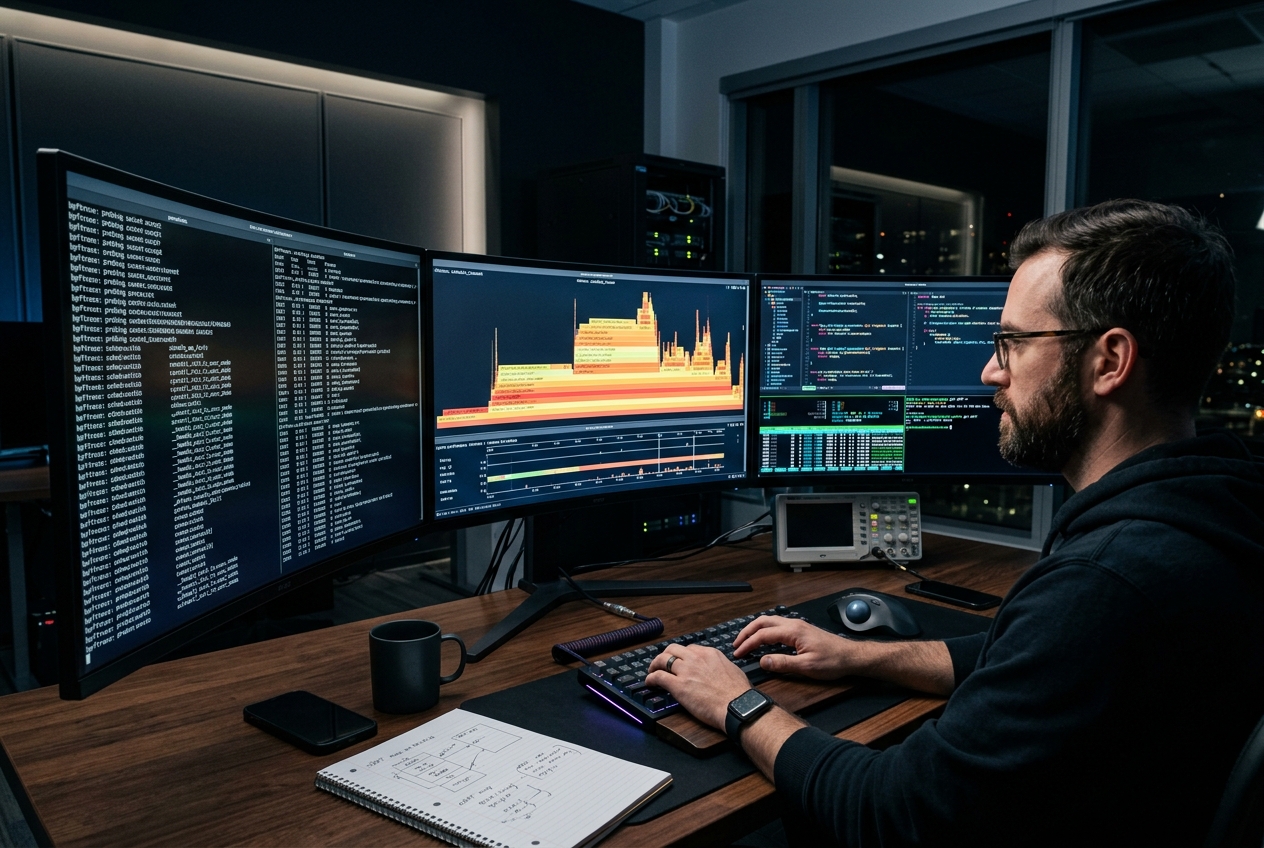
Instruments & Setup: Linux Kernel Profiling
Using Linux extended Berkeley Packet Filters (eBPF) via bpftrace and perf, we attached probes to every system call invoked by Cursor Composer (Version 0.44+) and Claude Code CLI during a full repository refactoring workflow. We tracked three specific syscall categories:
sys_enter_connect/sys_enter_sendto: Socket networking and WAN egress.sys_enter_execve: Local subprocess spawning (git, pytest, npm).sys_enter_read/sys_enter_write: Local disk I/O and JSON state persistence.
The Profiling Flame Graph Breakdown
The flame graph revealed startling inefficiency in the IPC (inter-process communication) boundary:
Total Task Time: 14.8 seconds
├── 0.4s: Local Process Execution (pytest execution + git diff calculation)
├── 1.2s: Context Serialization & AST Traversal
├── 9.8s: WAN HTTPS Roundtrips & Autoregressive Model Next-Token Sampling
└── 3.4s: Framework State Deserialization & Polling Idle
Over 89% of developer waiting time was spent outside the local compiler and operating system. The actual local code modification took under half a second; everything else was network serialization and autoregressive decoding stalls.
How System 1 Reflexes Restore Flow State
By delegating predictable intermediate steps (file inspection, status checks, schema confirmation) to an in-memory System 1 reflex head, developer tools cut end-to-end task times from 14.8 seconds down to 2.1 seconds, preserving developer flow state and saving engineering teams hundreds of hours annually.
Infrastructure Governance & Registrar Transfer
The canonical domain SystemOneAPI.com is available for corporate acquisition or enterprise licensing. Official registrar push available via Spaceship or Escrow.com security with immediate EPP authorization release.